
.png)


OUR WORK
A focused portfolio at the intersection of evidence, governance and implementation
Our experience combines assignments formally delivered through Green Angel Innovations with selected leadership and technical experience contributed by the professionals behind the company. To maintain transparency, company assignments and leadership experience are presented separately.
SELECTED WORK, INITIATIVES AND TRACK RECORD
Kenya, Nigeria, Tanzania, Malawi, Cameroon, Chad (2024-2026)
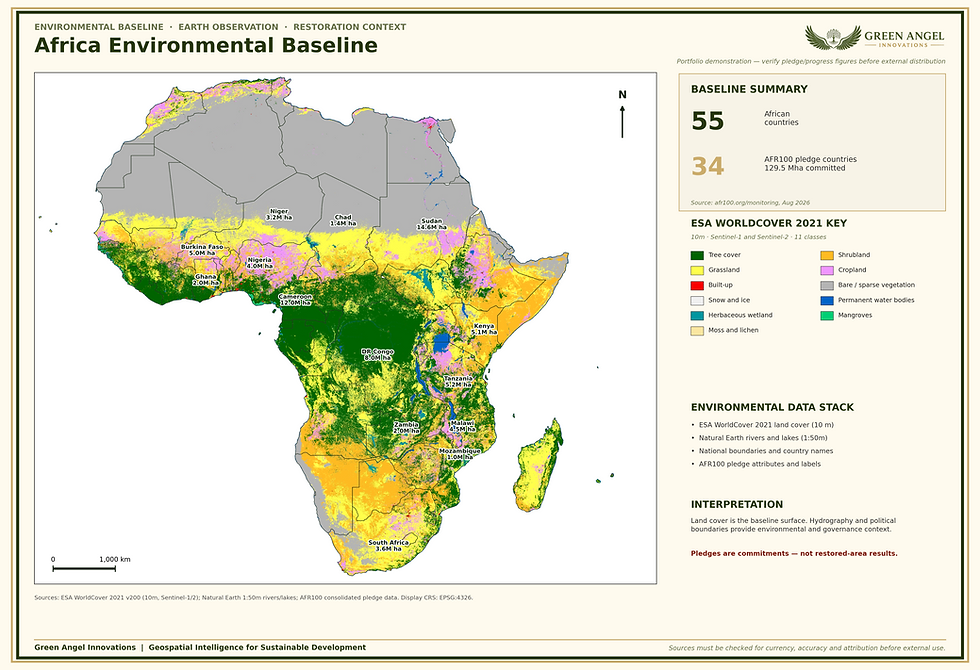
AFR100 Forest and Landscape Restoration Data and Monitoring
Client: African Union Development Agency - NEPAD
Geographic Scope: Malawi, Kenya, Nigeria, Tanzania
Programme: African Landscape Restoration Initiative
Assignment Period: 2024 - 2025
Role: Geospatial and Restoration Data Consultant
Green Angel Innovations' founder Dr Kofi Quartey was commissioned by AUDA-NEPAD to support the systematic collection, collation and analysis of spatial and non-spatial data on forest and landscape restoration activities across four AFR100 participating countries. The assignment contributed to strengthening the evidence base supporting the AFR100 Monitoring System, combining geospatial data management, field-data systems, satellite-image interpretation, restoration indicator reporting and country-level technical analysis to improve the accessibility and institutional use of restoration information.
SCOPE OF WORK
-
Reviewed available forest and landscape restoration data and related institutional documentation.
-
Deployed and supported ArcGIS Survey123 tools for structured country-level data collection.
-
Cleaned, validated, georeferenced and organised spatial and non-spatial restoration records.
-
Analysed relevant land-cover information and satellite imagery for identified restoration locations.
-
Supported the integration of survey information into the AFR100 geodatabase and monitoring environment.
-
Produced GIS maps, restoration statistics and country-level technical analysis.
-
Assessed data availability, reporting challenges, lessons learned and opportunities for scaling restoration practices.
OUTPUTS DELIVERED
CAPABILITIES DEMONSTRATED
The assignment strengthened the organisation and accessibility of restoration evidence across four participating countries, supporting more systematic monitoring, institutional reporting and evidence-informed decision-making within the AFR100 programme.
CONFIDENTIALITY & DATA GOVERNANCE
Reports, maps, datasets and software produced under this assignment are owned by AUDA-NEPAD and are not published publicly. Detailed client deliverables and underlying data are available for legitimate procurement, consortium or due-diligence purposes only, subject to client confidentiality and intellectual-property requirements.
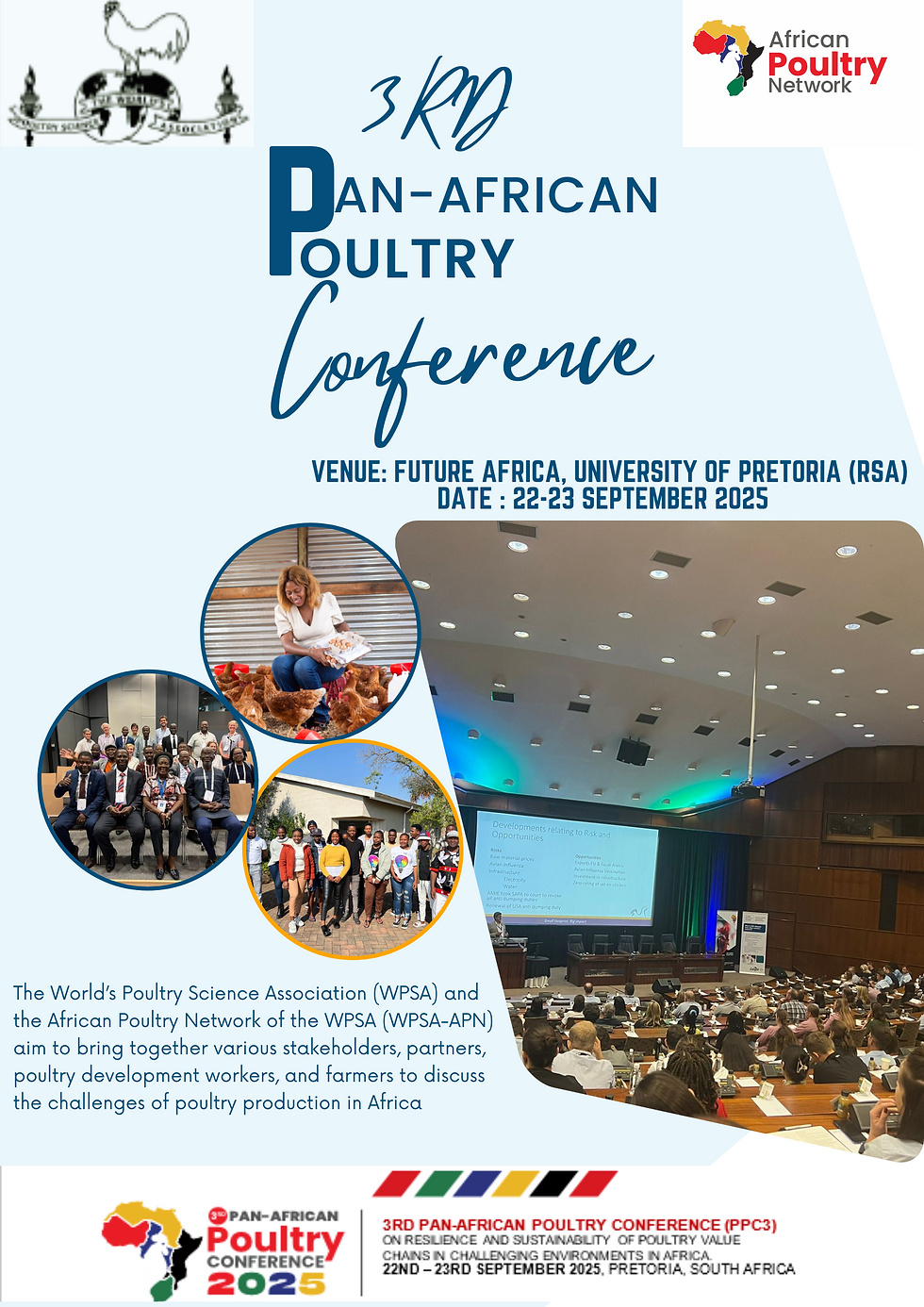
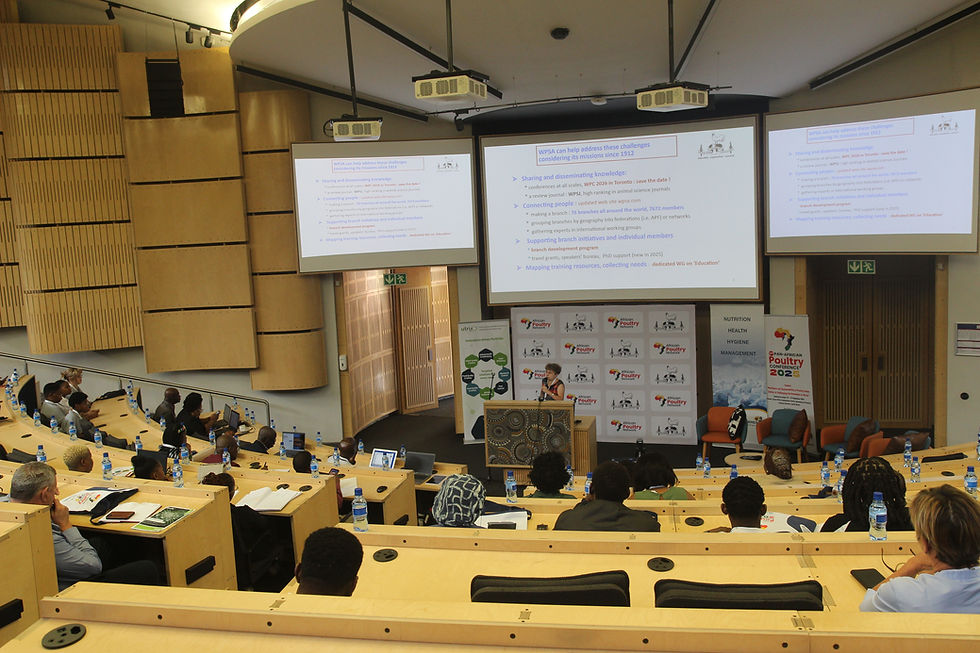
Future Africa, University of Pretoria, South Africa · 22–23 September 2025
The Third Pan African Poultry Conference (PPC3) Continental Communications and Digital Coordination
Organisation: African Poultry Network of the World Poultry Science Association (WPSA-APN)
Engagement period: 2024–2025
Role: Conference Media, Communications and Digital Coordination
Conference: Third Pan African Poultry Conference
Geographic Reach: 19 African Countries
Delivery Context: Founder-led contribution, with WPSA–APN, SEAD1, Vetworks Belgium and Vetlink South Africa
From 2024, Green Angel Innovations' founder, Dr Kofi Quartey, contributed to the planning and delivery of the Third Pan-African Poultry Conference convened by the African Poultry Network of the World (WPSA–APN). His responsibilities spanned continental stakeholder communications, conference media, digital-platform development, sponsorship mobilisation and international partner coordination — supporting engagement between WPSA–APN leadership across 19 African member countries, conference organisers, technical partners, invited speakers, prospective sponsors and industry stakeholders.
KEY CONTRIBUTIONS
-
Supported conference communications with African Poultry Network (APN) WPSA presidents and secretaries across 19 African countries.
-
Designed, developed and initially hosted the first dedicated WPSA–APN conference website, later transferred to the WPSA–APN mother body for continued institutional management.
-
Contributed to the preparation and refinement of the PPC3 conference proposal.
-
Researched and compiled prospective local and international sponsors, contributing to sponsorship packages and engagement strategies.
-
Supported sponsorship engagement involving Aviagen, BIOCHEM and Urban Farmer.
-
Coordinated online meetings and conference-related communications with Vetworks Belgium and Vetlink South Africa.
-
Supported speaker engagement, programme updates, registration coordination and conference announcements.
-
Collaborated with Sankofa Environmental and Agricultural Development (SEAD1) and the wider organising team on partnership, communication and administrative activities.
OUTPUTS DELIVERED
CAPABILITIES DEMONSTRATED
This work helped establish the communications and digital infrastructure needed to coordinate a continental professional network and support the organisation of an international poultry-sector conference. The subsequent transfer of the conference website to the WPSA–APN mother body enabled the platform to continue as an institutional communications asset beyond its original development and hosting phase.
Disclosure Notice
Selected supporting evidence may be made available for legitimate procurement, partnership or due-diligence purposes. Personal correspondence, shared-mailbox records and institution-owned material are not published publicly.
Africa · Pilot-Partner Mobilisation Stage
Green Angel Villages
Initiative: Green Angel Villages
Framework: FEWSS integrated settlement model
Geographic focus: Africa
Development stage: Concept development and pilot-partner mobilisation
Lead organisation: Green Angel Innovations
Green Angel Villages is a proposed regenerative settlement framework designed to improve how communities affected by displacement, mining, infrastructure development, climate stress and land degradation are planned, supported and sustained. The model integrates essential settlement systems such as food, energy, water, shelter, sanitation and mobility with livelihood restoration, ecological regeneration, secure land tenure, participatory governance and long-term monitoring, treating a settlement as a connected living system rather than a housing delivery exercise.
THE DEVELOPMENT CHALLENGE
-
Conventional resettlement programmes often concentrate on physical relocation and short-term compensation, while access to productive land, water, energy, livelihoods, markets and accountable governance remains inadequately addressed.
-
These gaps can expose communities, governments and project developers to loss of livelihoods, food and water insecurity, community fragmentation and increased dependence on external assistance.
-
Left unaddressed, they can also contribute to land degradation, weak post-resettlement accountability, continuing grievances and reputational, regulatory and social-licence risk for the institutions involved.
THE PROPOSED FRAMEWORK — SIX INTEGRATED SYSTEMS
-
Food: Climate-responsive production through agroforestry, household and communal cultivation, small livestock, aquaculture where appropriate, seed systems and local processing.
-
Energy: Context-appropriate renewable systems, including solar generation, battery storage, biogas and energy-efficient settlement design.
-
Water: Integrated water-security planning covering source assessment, rainwater harvesting, storage, filtration, greywater reuse and watershed protection.
-
Shelter: Safe, climate-responsive, culturally appropriate housing designed around local materials, affordability and lifecycle performance.
-
Sanitation: Decentralised sanitation and resource-recovery systems selected for environmental conditions, health requirements and regulatory standard.
-
Mobility: Safe, affordable access solutions including walking and cycling infrastructure, shared transport and connections to markets, services and livelihoods.
GEOSPATIAL INTELLIGENCE ACROSS THE MODEL
GIS and Earth observation are intended to support the model across its lifecycle, from site selection through to long-term performance monitoring, connecting the initiative directly to Green Angel Innovations' core positioning in geospatial intelligence for sustainable development.
FIELD WORK AND INSTITUTIONAL ENGAGEMENT
A visual record of assignments and initiatives - field documentation, technical outputs and event coverage.
AFR100 ILLUSTRATIVE VISUALS


THE THIRD PAN AFRICAN POULTRY CONFERENCE (PPC3)

APPLIED GEOSPATIAL ANALYSIS
Independent studies translating satellite and spatial data into decision-ready insight,
across governance, climate, humanitarian, and private-sector contexts in Africa


CREDENTIALS & TECHNICAL RESOURCES
Reference documents for institutional review
Available to institutional partners, consortium members and prospective clients on request.

Capability Statement
A concise summary of core service lines, suited for tenders and consortium submissions.
Available on Request
AFR100 Assignment Brief
A concise, non-confidential overview of the geospatial methods, technical scope and institutional contribution of the four-country AFR100 restoration data assignment.
Available on Request
PPC3 Project Brief
An overview of the founder's contribution to the Third Pan-African Poultry Conference — communications, digital coordination and sponsorship engagement across 19 countries.
Available on Request
Disclosure Notice
Detailed client deliverables and underlying datasets are not published publicly. Selected evidence may be made available for legitimate procurement, consortium or due-diligence purposes, subject to client confidentiality and intellectual-property requirements.


